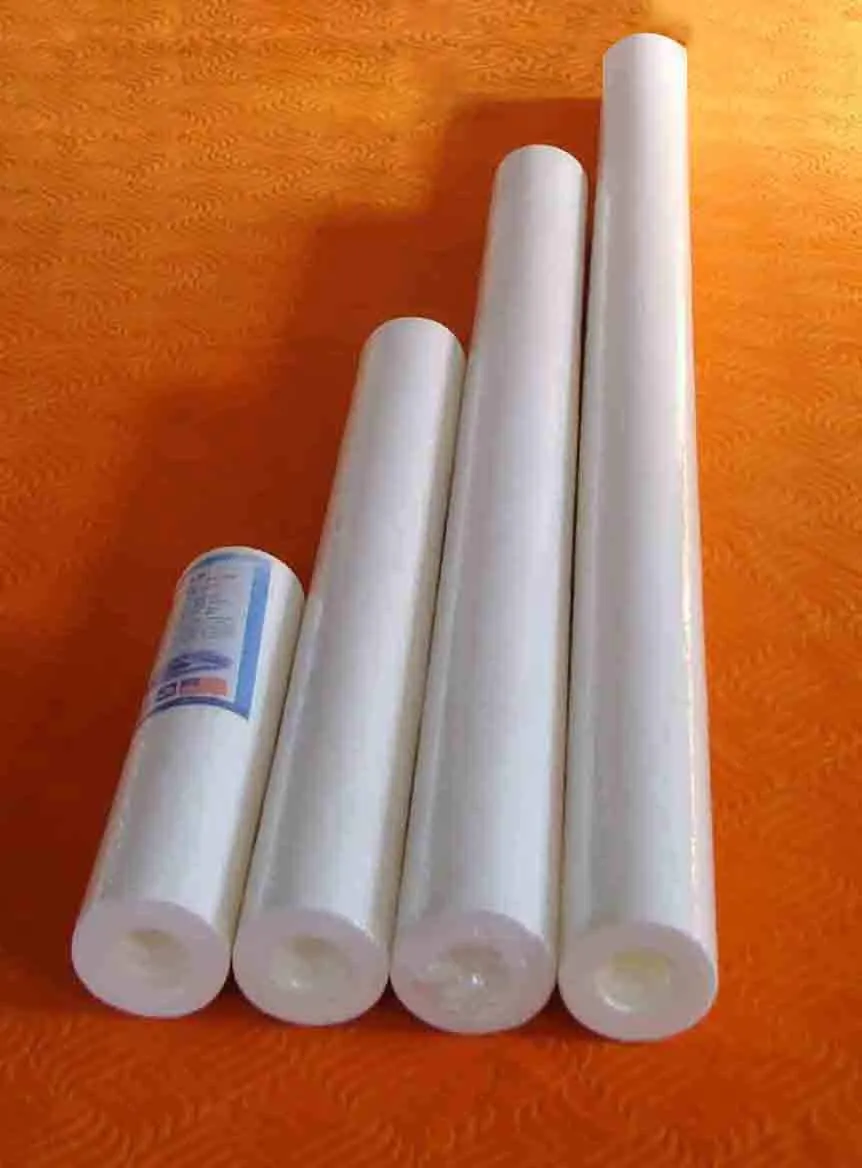
PP melt blown and carbon block are two of the most popular filter cartridge types in industrial water treatment. While they are often used together in multi-stage filtration systems, they serve very different purposes.
This guide compares them across 10 key dimensions: filtration mechanism, micron rating, contaminant removal, chlorine reduction, sediment holding capacity, flow rate, operating temperature, chemical compatibility, cost, and typical applications.
Quick Comparison Table
| Specification | PP Melt Blown | Carbon Block |
|---|---|---|
| Filtration Mechanism | Depth filtration (physical) | Adsorption + depth |
| Micron Rating | 1 - 50 μm ✅ | 0.5 - 10 μm |
| Chlorine Removal | ❌ No | ✅ Yes (up to 99%) |
| Sediment Holding | ✅ High (deep gradient) | Moderate |
| Taste & Odor | ❌ No | ✅ Excellent |
| VOC Reduction | ❌ No | ✅ Yes |
| Flow Rate | ✅ High | Moderate |
| Max Temperature | 60°C ✅ | 52°C |
| Chemical Resistance | ✅ Excellent | Good |
| Cost per Cartridge | $2 - $8 ✅ | $5 - $15 |
| Typical Lifespan | 3-6 months | 6-12 months ✅ |
| Best Use | Sediment pre-filtration | Polishing & purification |
1. Filtration Mechanism: How They Work
PP Melt Blown — Depth Filtration
PP melt blown cartridges are made by melting polypropylene and extruding it through fine nozzles to create microfibers. These fibers are randomly layered to form a gradient density structure — coarser on the outside, finer toward the core. This allows the cartridge to trap particles throughout its depth, not just on the surface.
Carbon Block — Adsorption + Filtration
Carbon block cartridges are made from compressed activated carbon (typically coconut shell-based) mixed with a binding agent. They remove contaminants through adsorption — contaminants chemically bond to the carbon surface — combined with physical filtration through the porous carbon structure.
2. Contaminant Removal Comparison
| Contaminant | PP Melt Blown | Carbon Block |
|---|---|---|
| Sediment & Sand | ✅ Excellent | ✅ Good |
| Rust & Pipe Scale | ✅ Excellent | ✅ Good |
| Chlorine | ❌ | ✅ Excellent |
| Chloramine | ❌ | ✅ Good |
| VOCs (chemicals) | ❌ | ✅ Excellent |
| Taste & Odor | ❌ | ✅ Excellent |
| Cysts (Giardia) | ✅ (1 μm) | ✅ (0.5 μm) |
| Heavy Metals | ❌ | ✅ Partial |
| Microplastics | ✅ (≥1 μm) | ✅ (≥0.5 μm) |
3. Which One Should You Use?
Use PP Melt Blown when:
- Pre-filtration for RO systems — Protects RO membranes from sediment fouling
- High sediment water — Well water, river water, or older pipe systems
- High flow applications — The depth structure allows higher flow rates
- Budget-conscious projects — Lower cost per cartridge replacement
Use Carbon Block when:
- Chlorine removal needed — Municipal water supplies with chlorination
- Taste and odor improvement — Drinking water, food & beverage applications
- Post-filtration / polishing — After sediment filtration in multi-stage systems
- Chemical contaminant reduction — VOCs, pesticides, industrial chemicals
4. Best Practice: Use Them Together
In most industrial water treatment systems, PP melt blown and carbon block cartridges are used in series:
- Stage 1: PP Melt Blown (5-20 μm) → removes sediment, rust, and large particles
- Stage 2: Carbon Block (5-10 μm) → removes chlorine, taste, odor, and chemicals
- Stage 3 (optional): RO Membrane → removes dissolved solids, heavy metals
This 3-stage configuration is the industry standard for commercial and industrial water treatment systems worldwide.
Need Both Types for Your Project?
We supply OEM-grade PP melt blown and carbon block cartridges in all standard sizes. Bulk pricing available for volume orders.
Request a Quote →FAQ
Can I use carbon block alone without PP pre-filter?
Yes, but the carbon block will clog faster if the water contains high sediment. A PP pre-filter extends the carbon block's lifespan by 2-3x.
How often should I replace each type?
PP melt blown: every 3-6 months. Carbon block: every 6-12 months. Replace sooner if you notice pressure drop or reduced flow.
Which type is better for well water?
PP melt blown is essential for well water pre-filtration due to higher sediment levels. Add carbon block after for taste and odor improvement.