PP Melt Blown vs Wound Filter Cartridges: Which One for Your Application?
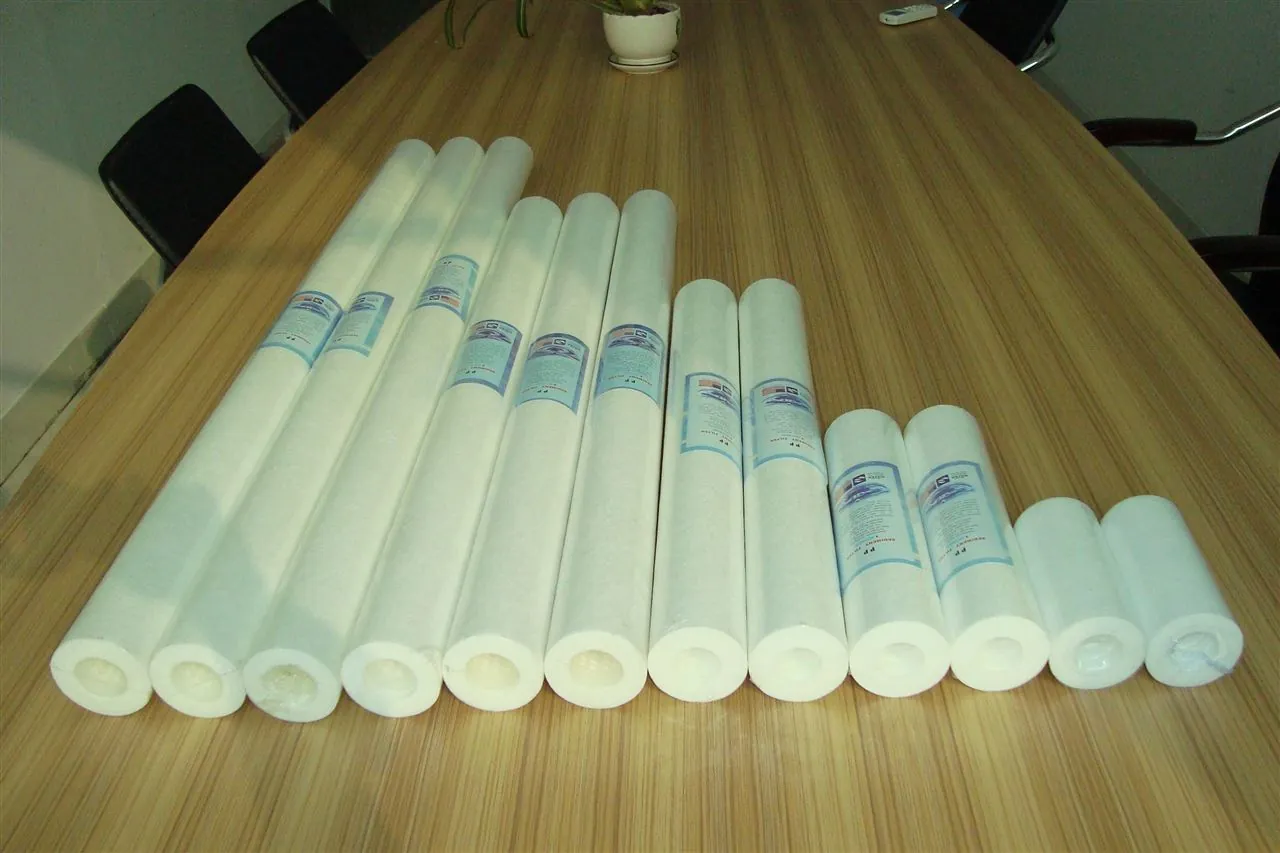
PP melt blown and string wound filter cartridges are the two most common depth filter cartridges in industrial water treatment. Both remove suspended particles, but they work differently and suit different applications. Choosing the wrong type means either paying more than necessary or getting shorter cartridge life. This guide compares the two technologies so you can decide with confidence.
How Each Cartridge Is Made
PP melt blown cartridges are produced by melting polypropylene and blowing it through fine nozzles to form a web of microfibers that is layered around a core. The result is a graded-density structure: coarse on the outside, finer toward the center. This gives excellent dirt-holding capacity across the full depth of the cartridge.
String wound cartridges are made by winding yarn (polypropylene, cotton, or fiberglass) around a central core under controlled tension. The winding pattern creates a maze of channels that trap particles. Wound cartridges are typically uniform-density throughout.
Key Differences at a Glance
| Property | PP Melt Blown | String Wound |
|---|---|---|
| Filtration mechanism | Graded-depth microfiber web | Uniform-depth yarn maze |
| Typical micron ratings | 0.5–100 µm | 0.5–100 µm (commonly 5–50 µm) |
| Dirt holding capacity | High (graded structure) | High (yarn channels) |
| Particle release tendency | Very low | Low to moderate |
| Chemical compatibility | Excellent (pure PP) | Depends on yarn material |
| Typical cost | Slightly higher | Generally lower |
| Best for | Fine filtration, critical processes | Pre-filtration, high-sediment water |
When to Choose PP Melt Blown
- You need consistent, high-efficiency particle removal at ratings of 5 µm or finer
- Process water quality matters (food, beverage, pharmaceutical, electronics)
- You want minimal fiber or binder release into the water
- Your water is chemically aggressive — pure PP resists most acids and alkalis
When to Choose String Wound
- Feed water has very high sediment load and you want the lowest cost per liter filtered
- You need a pre-filter upstream of fine cartridges or RO membranes
- You need cotton or fiberglass construction for specific compatibility
- Your application is conventional cooling water or general process filtration
Practical Selection Advice
For most industrial systems, a combination works best: a 20–50 µm wound cartridge as a pre-filter, followed by a 1–5 µm melt blown cartridge for final filtration. This staged approach maximizes total dirt-holding capacity while protecting the fine stage from rapid blinding. Whichever type you choose, standardize on one manufacturer for consistent quality — cartridge dimensions, core materials, and micron ratings vary between suppliers.
Get OEM-Compatible Cartridges at Factory Prices
Jingze Water manufactures both PP melt blown and string wound cartridges in 10", 20", 30", and 40" lengths, with standard and custom micron ratings. We supply OEM-compatible cartridges for most major housing brands, with consistent quality batch after batch. Contact us for samples and bulk pricing.